
PhD Student in the Department of English, University of Toronto
“Transformation as Translation: The Material Forms of Jane Seager’s The Divine Prophecies of the Ten Sibills”
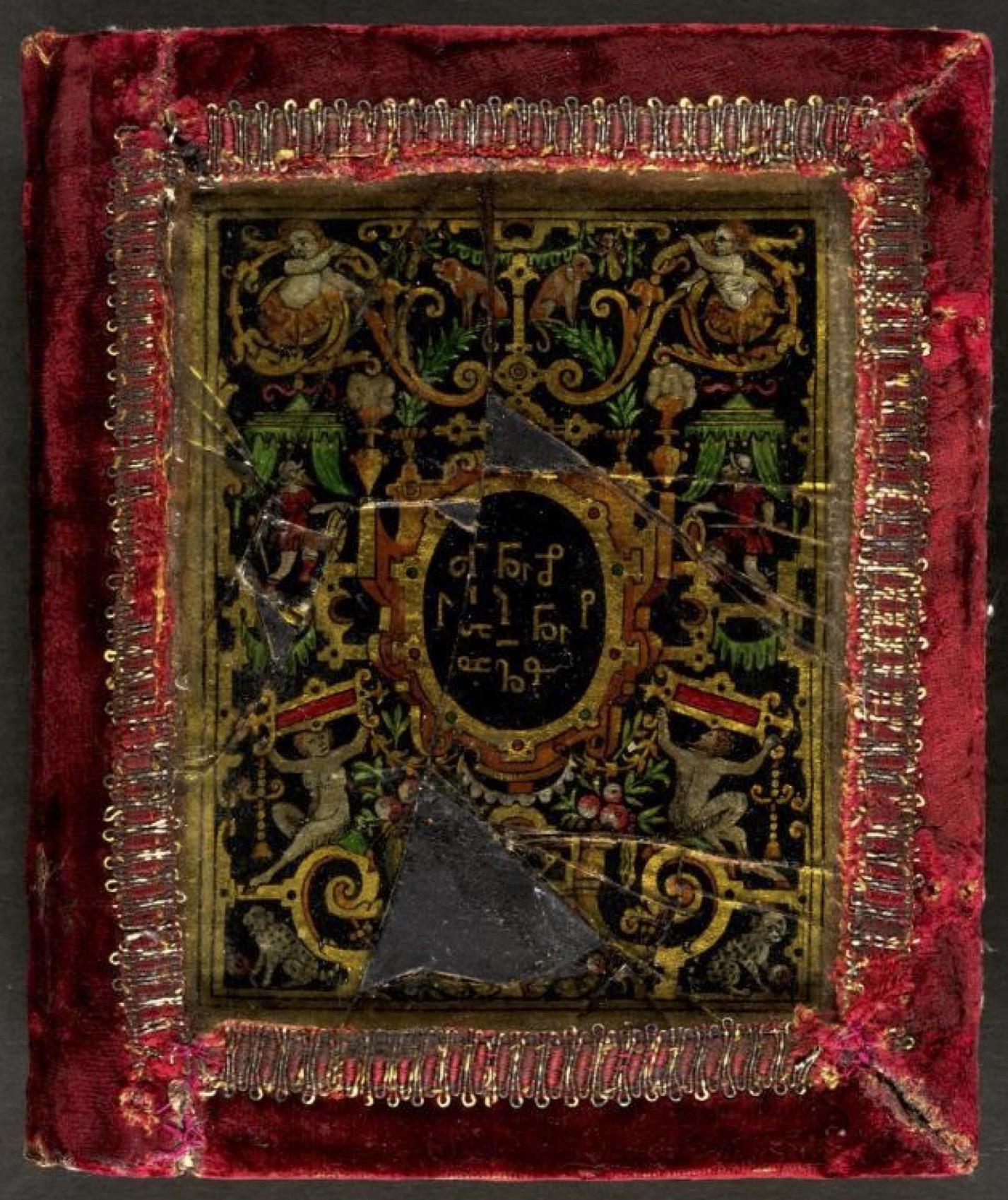
In 1589, a woman named Jane Seager painstakingly crafted an ornate gift-book (British Library, Add MS 10037), bound in red velvet and lined with silver thread, protected by two covers of intricately painted glass. Within the covers lies the text The Divine Prophecies of the Ten Sibills, which Seager carefully translated into English from Latin on the verso pages. Yet the recto pages feature further translative work by Seager, this time into a new system of writing that was invented by Dr. Timothy Bright and published in his work Characterie: An Art of Shorte, Swifte, and Secrete Writing by Character (1588). Characterie transforms English words into “characters,” or shapes made of lines and circles that appear almost hieroglyphic. In this paper, I examine how Seager’s choice to translate Latin into English and then into Characterie, specifically with the text of the sibylline prophecies, emphasizes the formal significance of language through the materiality of form. Considering the entire text as a material artefact, I will explore how the glass covers of this gift-book, intended to be given to Elizabeth I, physically embody the idea that any form of material expression of language functions as an encoded representation of communication. I study how the techniques employed by Seager in this gift-book, both the reverse painting on glass (verre églomisé) and the prominence of Characterie on the covers, invite the reader to consider how one’s relationship with language mirrors their relationship with the divine.
PhD Student in the Department of Spanish, University of Toronto
“Melancholic Princes: Individual Disorder as a Metaphor for Sociopolitical Crisis in La vida es sueño by Calderón de la Barca”
This presentation examines a physiological condition manifested in Early Modern Spain: the melancholic disorder, and its connection to the sociopolitical context of the Spanish Empire, which was marked, during the seventeenth century, by the fear of political dismemberment. Hence, I propose a close reading of the problem of succession to the throne in La vida es sueño (1635) by Calderón de la Barca. In this play, melancholic disorder affects the characters’ mental faculties and produces extreme emotions that destabilize both the familial and political spheres. To analyze the effect of these emotions, I draw from the concept of corpus mysticum, an organic metaphor that directly connects the individual body of the monarch with the political body. As such, I argue that melancholy, as a personal affliction, fractures the realm by diverting the king from the duties of governance toward subjective mental creations like Basilio’s unfounded prophecy, whereby his first son, Segismundo, would become a tyrant.
Tuesday, March 17, 2026
4:00–5:30pm
Victoria University Common Room
91 Charles St W


