
PhD Student in the Department of History, Queen’s University
“Turquerie and Material Culture in Enlightenment France“
Cafés are one of the quintessential images conjured when thinking about Parisian culture. In the seventeenth and eighteenth centuries, these spaces were important social hubs, and reflected France’s fascination and emulation of Ottoman and Turkish material culture, also known as turquerie. Alexander Bevilaqua, Helen Pfeifer, Nebahat Avcıoğlu, Hayden Williams, and Marcus Keller, among other scholars, have dutifully researched and documented some of the ways that turquerie has impacted the relationship between France and the Ottoman Empire. This type of material culture can also reflect constructions of the “Other” as well as constructions of French identity during the European Enlightenment — not necessarily through exact replication, but through “fractured reflections” of Ottoman influence.
This paper will explore how material culture, like Ottoman-inspired architecture that facilitated indoor-outdoor fluidity, and relaxed furnishings that shifted from rigid court styles, to more comfortable arrangements, fostered a public sphere influenced by a growing fascination with novelty and the exotic created by turquerie. It made these goods and environments accessible, driving public discourse and contributing to the emergence of a new publicness, constructing ideas about French and Ottoman identity, as well as daily life and interaction in urban settings, in an increasingly global world.
PhD Student in the Daniels Faculty of Architecture, Landscape, and Design, University of Toronto
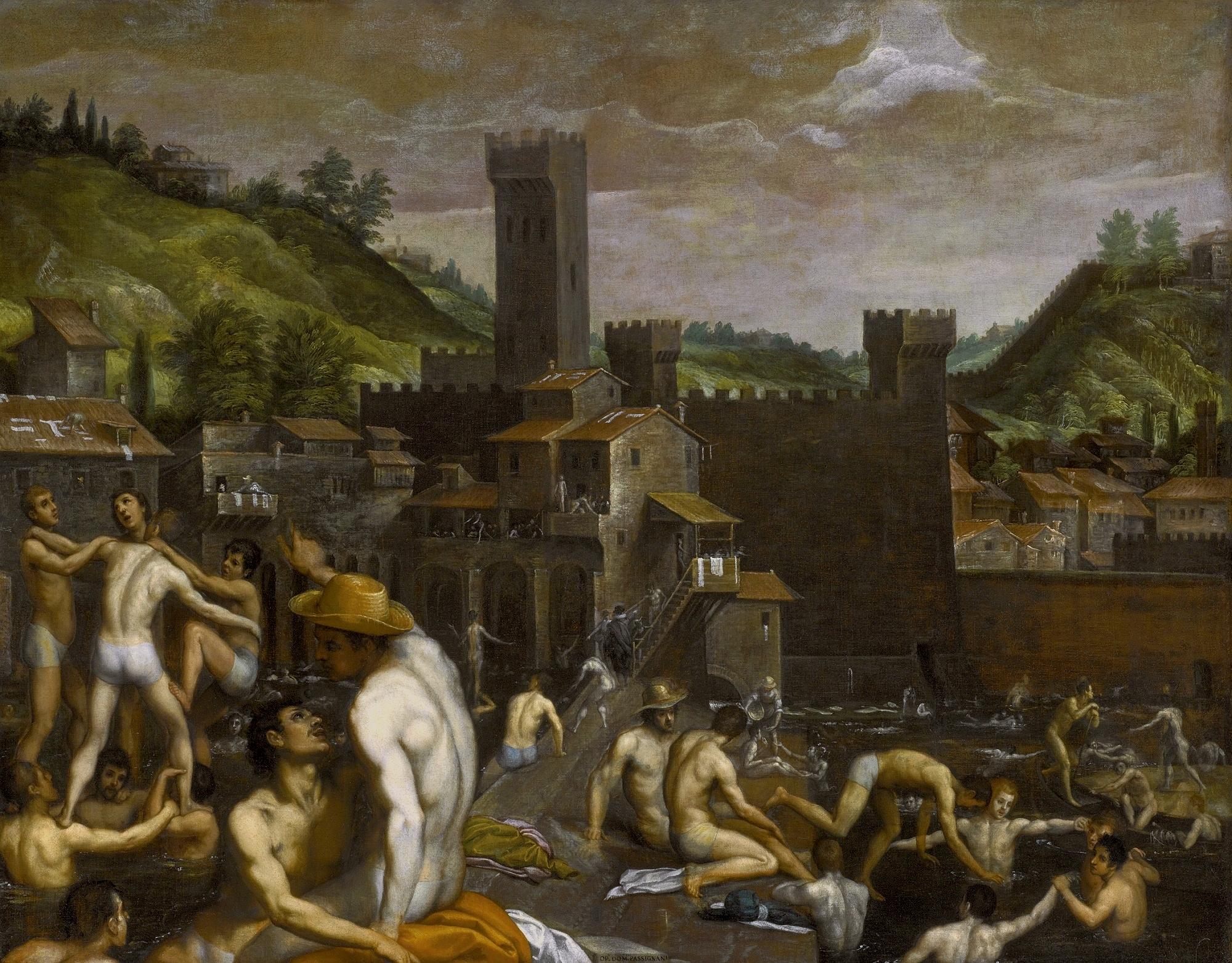
“Que(e)rying Passignano: Baths, Bodies, Brutalities (1432-1600)”
This paper examines the “carnal sin” of sodomy in early modern Florence, Italy (1432–1600). More specifically, this project investigates one particular sodomitical locale: the San Niccolò bathhouse. Domenico Cresti’s (called ‘Il Passignano’) Bathers at San Niccolò (1600) depicts a contemporaneous scene of all-male bathing, imbued with homosexually suggestive acts within a locatable urban space. What can this particular image tell us about the lived realities of sodomy in early modern Florence? When examined alongside topographical, legal, health, and religiopolitical archives, Bathers illuminates the intricacies of same-sex pleasure and punishment. In identifying this specific site along the Arno River, and combining Bathers with various written documents, one can better achieve a history of sexual persecution, its surveillance, and institutional efforts to control illicit sex across the urban landscape.
The bathhouse, a simultaneously public and private space, was a center for relaxation, sociability and health but also functioned as an arena for homosexual encounters. Sodomy was blasphemous, generating anxiety throughout early modern Italian city-states. Citizens feared for their safety: a sodomite in their midst could provoke divine wrath, as it had in the biblical narratives of Sodom and Gomorrah—sexual sins could lead to urban destruction. Police forces were created to surveil and punish such abominable acts in order to maintain the sacrality of the urban interior.
While these magistracies policed every parish, the Florentine bathhouse was more challenging: it permitted nakedness and, as such, often resulted in unsavory interactions between men. How might topographical and painterly representations of water, wantonness, and punishment allow the historian to check written accounts (legal, religious, literary) of sexual encounters within specific architectures—and vice versa? Looking at and beyond the figures in Bathers, this project investigates the represented backdrop in which sodomitical activities are depicted. In so doing, this project engages with larger historiographical issues, namely the ways in which studies on premodern sex and gender have and have not been mobilized through postmodern theories. This project combines Passignano’s artwork with other visual and written materials to challenge and expand on the ways in which sex, space, art, and society functioned in Renaissance Florence.
Thursday, January 29, 2026
4:00–5:30pm
Victoria University Common Room
91 Charles St W


