
With an Introduction by Professor Ethan Matt Kavaler, Department of Art History
Ph.D. Candidate, Department of Art History
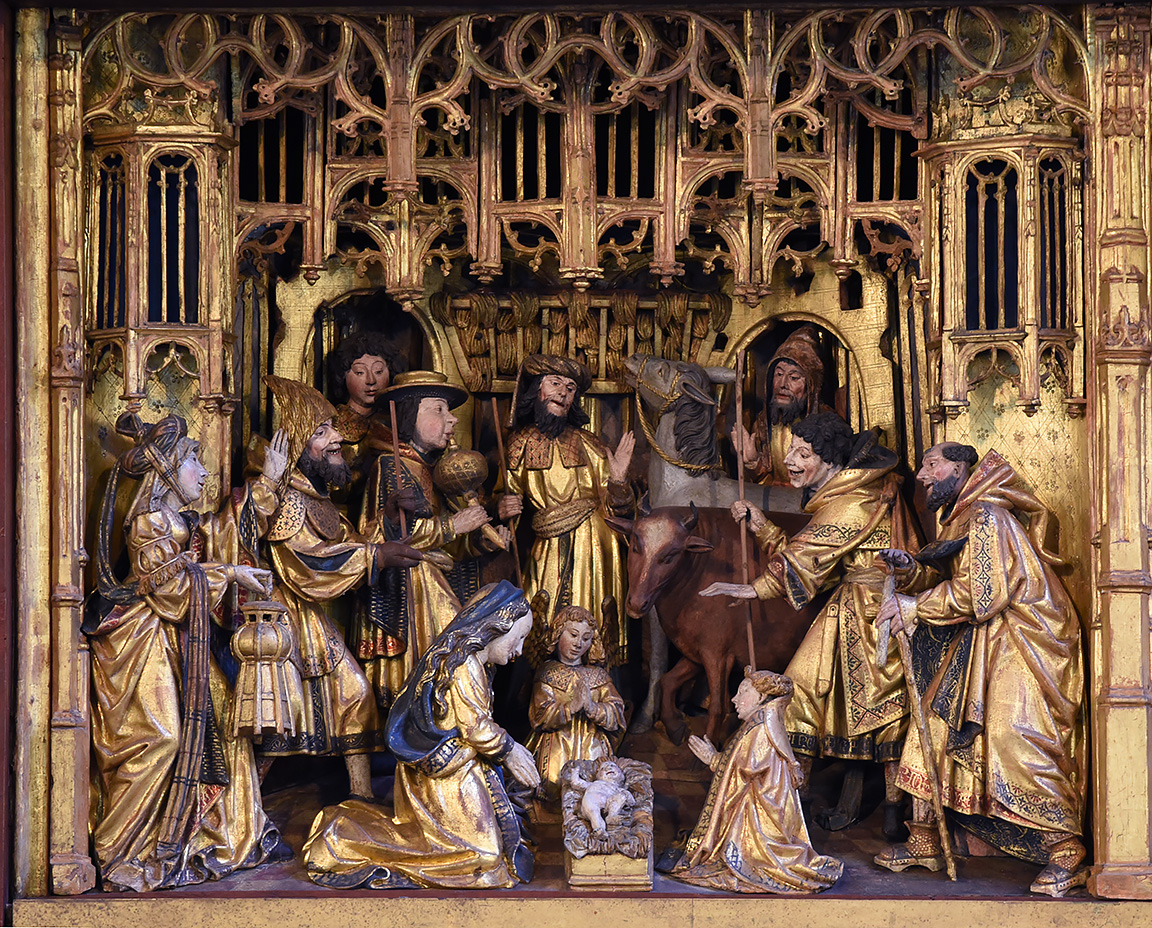
In his canonical Early Netherlandish Painting (1953), Erwin Panofsky dismisses the Netherlandish carved altarpiece as an artistic form out of step with developments in Netherlandish panel painting. Whereas painting uses perspective to produce unified, autonomous images, he argues, carved altarpieces merely present “free agents acting on a stage.” Panofsky’s negative assessment of the carved altarpiece, I argue, obscures the unique phenomenology of this devotional object. Unlike paintings, the stage-like structure of carved altarpieces enabled implicative, participatory devotional encounters in which beholders were invited to recognize Christ’s corporeal presence at the altar. By comparing the phenomenology of carved relief with that of panel painting, this paper foregrounds the carved altarpiece’s distinctive and understudied medial affordances and their role in shaping contemporary devotional practices. In so doing, this contribution repositions the carved altarpiece within the historiography of early Netherlandish art and offers a new account of its widespread popularity across Europe from c. 1380 to 1550.
Ph.D. Candidate, Department of Art History
The dazzling and gilded carved shrines of Netherlandish altarpieces were often hidden from view by painted wings, only to be revealed on the holiest feast days. This exploratory paper examines representations of altars within these painted panels, which enclosed actual altarpieces, with particular attention to depictions of the Adoration of the Eucharist and the Mass of St. Gregory, subjects that rose in popularity on the exteriors of carved altarpieces in the first decades of the sixteenth century. I address both the stylistic and temporal aspects of this sculptural conceit: the interplay of the gothic with the introduction of elements in the antique mode, as well as experiments in depicting the paradoxical notion of a pre-Christian altarpiece.
Tuesday, September 29, 2026
4:00–5:30pm
Victoria University Common Room
91 Charles St W


