

Tuesday, 10 November, 2026
4:00pm–5:30pm
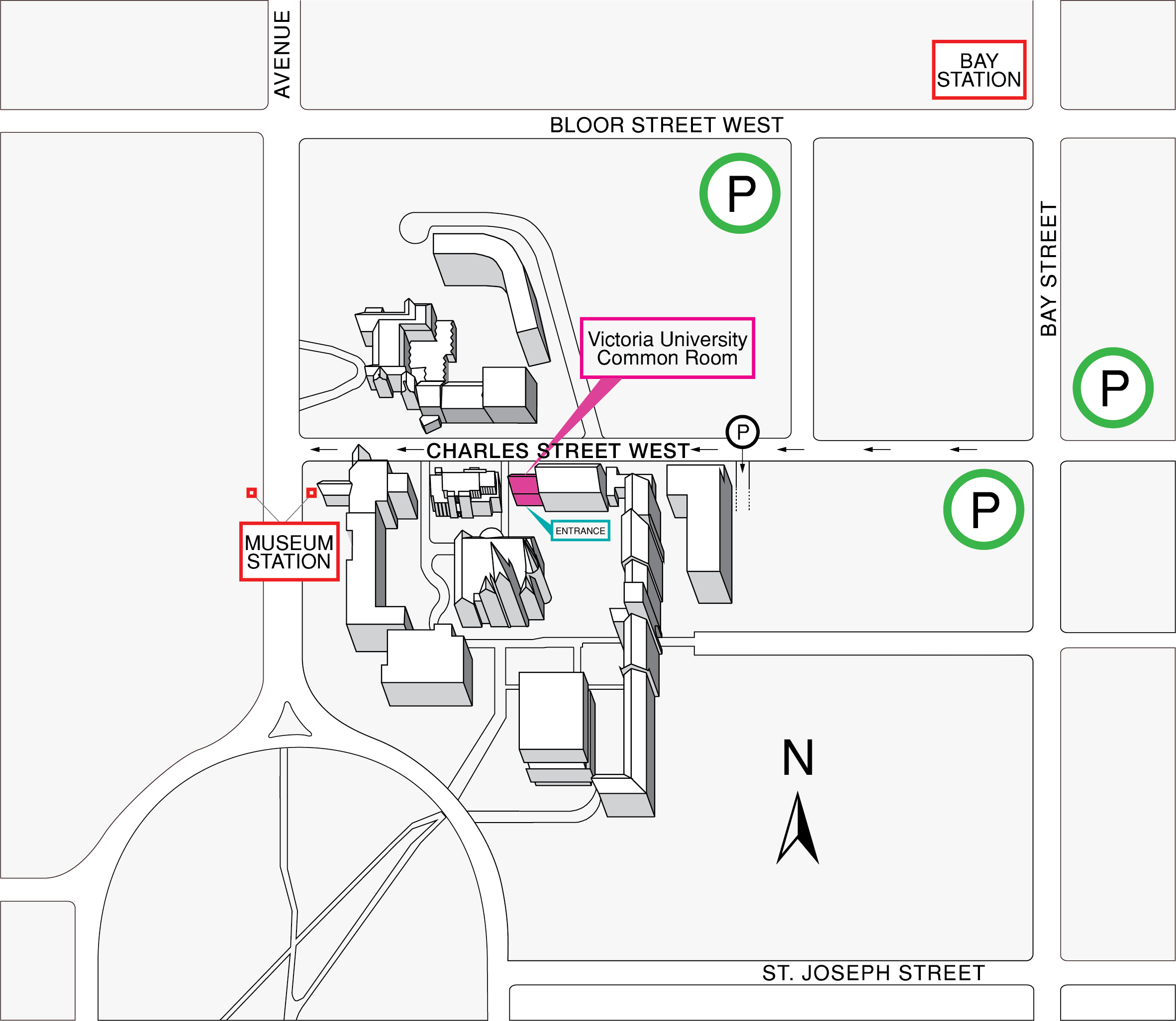
Victoria University Common Room
91 Charles St W
In 1627, amidst a very public dispute on who should be treated by King Charles I as the legitimate ambassador for Persia, English adventurer Robert Sherley had to defend his diplomatic credentials to the English court. The title of ambassador was also being claimed by Naqd Ali Beg, another envoy from the Persian Shah, whose presence in England was sponsored by the English East India Company. Faced with a King who refused to weigh in on the contest and a powerful corporation who was working against him, Robert Sherley turned to visual propaganda in order to support his fragile diplomatic position. He commissioned a set of twin portraits of himself and of his wife, Teresia Sherley, a Circassian raised at the Persian court and given to him in marriage by Shah Abbas. The two portraits, made by an anonymous English artist in 1627, show Robert wearing a turban and khila’t (the coat offered by Muslim emperors to ambassadors or honoured guests), while the foreign-born Teresia wears a fully English dress. However, Teresa’s portrait also depicts her holding a pistol and a watch, in what might very well be the earliest instance of a work by an English painter depicting a woman holding a firearm. In this talk, I will explain the Anglo-Persian context of the portrait and I will use the double lens of diplomacy and art history to shed light on the bold choice made by the painter to depict a foreign woman in England holding a firearm amidst an internal dispute at the English court.

Mathilde Alazraki is a Lecturer in early modern English history at the Université de Rouen Normandie in France and part of the ERIAC research unit (UR 4705). Her PhD thesis, defended in 2023 in Paris, is entitled “Women and Diplomacy between England and the East during the Early Modern Period (1558-1676).” She has published a chapter on the Persian characters of Mary Wroth’s romances in The Lives and Afterlives of the Sidney Women Writers (eds. Alison Findlay and Aurélie Griffin, Routledge) and is currently working on a chapter about race and empire in Mary Wroth’s works for the upcoming Cambridge Companion to Mary Wroth (ed. Katherine R. Larson, Cambridge University Press). Her other current projects involve the reworking of her thesis toward a future publication, as well as her participation in the “Re-Orienting Female Mobility in the Early Global World” project, a joint initiative by the Université Paris Cité and the University of Toronto aiming to create a database of medieval and early modern female travellers between Europe and Asia.


